Fork Pressure Test
Press a fork on food to check softness. Food should yield easily.
T/SATA 094-2025 — the standard our competitors must comply with.
IDDSI-aligned standards for safe, dignified eating for people with swallowing and chewing difficulties.
“Carewells Limited is one of three Participating Drafting Units (參編單位) of T/SATA 094-2025 (Chinese group standard, Greater Bay Area scope — ttbz.org.cn registry), alongside two mainland China research institutes. We helped write the technical requirements that all care food suppliers in the Greater Bay Area must now meet.”
Care food refers to food and beverages specially designed for people with swallowing (dysphagia) or chewing difficulties. By adjusting texture, softness, and viscosity, care food enables safe eating while preserving nutrition, colour, aroma, and flavour — allowing users to enjoy meals with dignity.
Without unified standards, caregivers, medical institutions, and food manufacturers face inconsistency in describing, preparing, and labelling care food. Standardisation ensures that a 'Level 4 pureed meal' means the same thing in a hospital, a care home, and a supermarket — supporting texture-modified options designed to support safer swallowing per IDDSI framework guidance and improving quality of life.
The International Dysphagia Diet Standardisation Initiative (IDDSI) is the globally recognised framework. It classifies food and drinks into 8 levels (0–7) using standardised names and simple testing methods (fork/spoon pressure test, flow test, syringe test).
| Level | Name | Suitable for |
|---|---|---|
| 7 | Regular / Easy to Chew | General population |
| 6 | Soft & Bite-Sized | Reduced chewing ability |
| 5 | Minced & Moist | Missing teeth / ill-fitting dentures |
| 4 | Pureed | Cannot chew |
| 3 | Moderately Thick / Liquidised | Severe dysphagia |
| 2 | Mildly Thick | Mild thickening needed |
| 1 | Slightly Thick | Basic fluid control |
| 0 | Thin | Normal liquids |
Source: iddsi.org
The Hong Kong Council of Social Service (HKCSS), in collaboration with CUHK Food Research Centre and HKU Swallowing Research Lab, developed a localised set of care food standards based on IDDSI. These apply to individual users, medical institutions, and food manufacturers.
Press a fork on food to check softness. Food should yield easily.
Tilt a spoon of pureed food. It should hold its shape, not flow freely.
Check liquid viscosity using a 10mL syringe. Flow rate determines IDDSI level.
Carewells (康樂齡's parent brand) co-authored three national group standards for the care food industry in mainland China:
Core technical specifications for care food products sold in mainland China.
Classification framework aligning Chinese market categories with IDDSI levels.
Standardised labelling so consumers and caregivers can identify correct IDDSI levels at a glance.
Standards published via softmeal.org. Citation: Carewells / SeniorDeli (2025). T/SATA 094-2025, T/SATA 084-2025, T/SATA 085-2025.
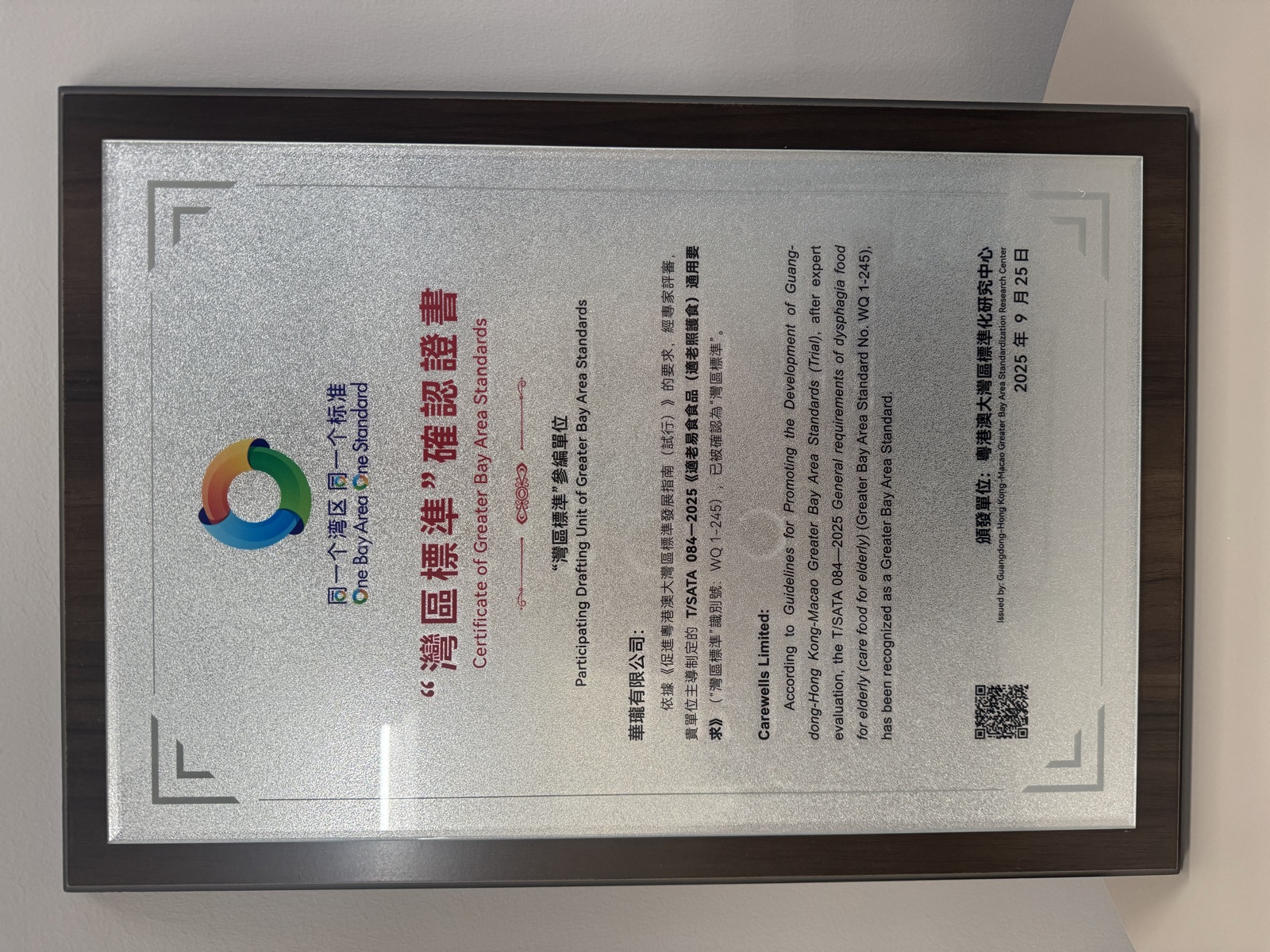
T/SATA 094-2025 Certificate — GBA Care Food Industry Standard (Carewells co-authored)
✗All elderly people have dysphagia.
✓Swallowing ability changes with age, but not all elders develop dysphagia. Assessment is needed.
✗Care food can treat dysphagia.
✓Care food supports safe eating but does not replace medical treatment or speech therapy.
✗The thicker the food, the safer.
✓Over-thickening increases choking risk, reduces appetite, and can cause dehydration.
The Greater Bay Area's first comprehensive dysphagia care food Group Standard, published September 2025. Carewells is a Participating Drafting Unit. See the standard's content, IDDSI alignment, and SeniorDeli product compliance details.
Browse SeniorDeli's IDDSI-compliant care food products.